

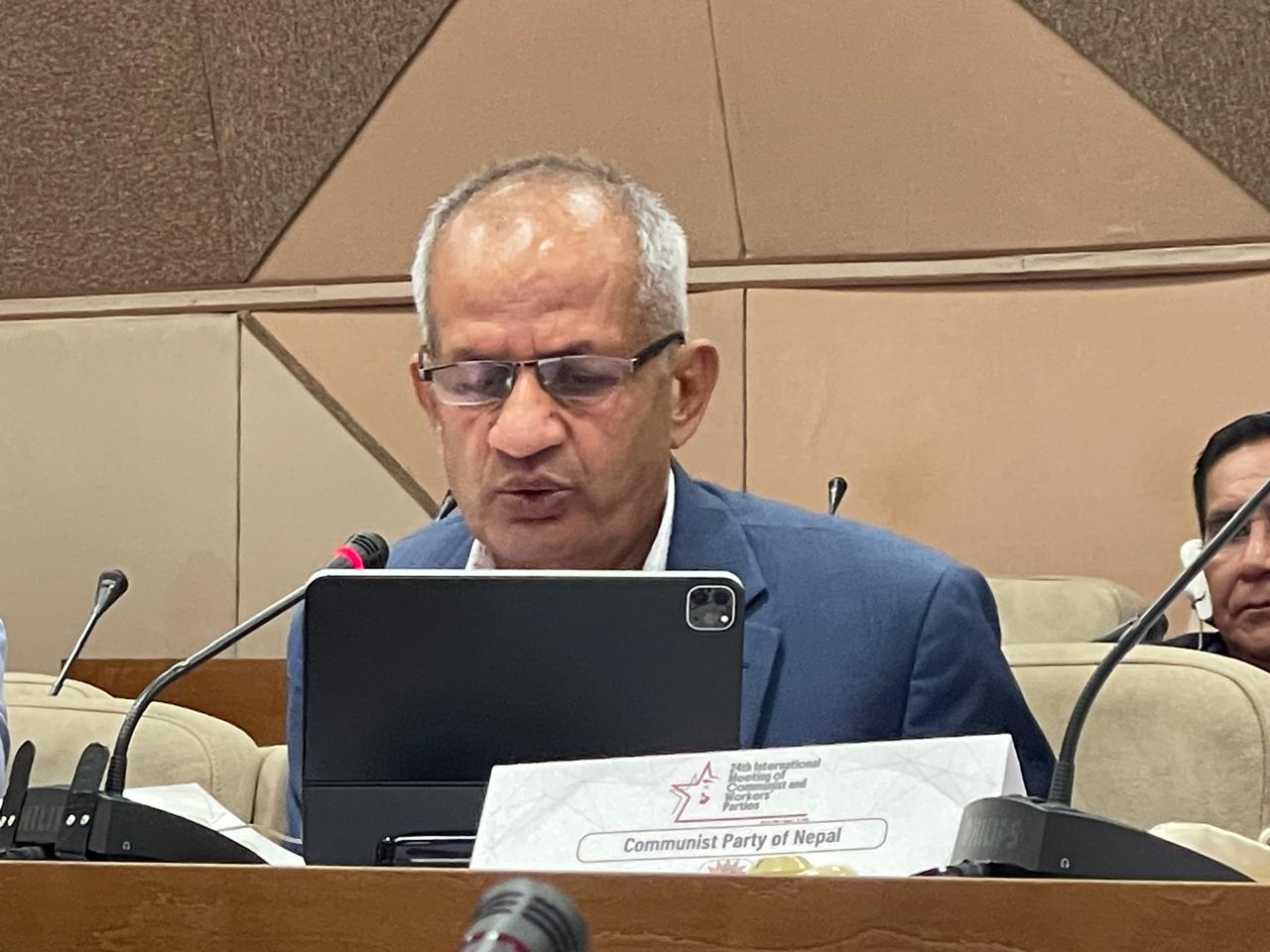
By Pradip Gyawali (KATHMANDU) – It is a profound honor and privilege for me to address the 24th International Meeting of Communist and Workers’ Parties (EIPCO) here in Havana. I extend my heartfelt gratitude to the Communist Party of Cuba (PCC) for their warm hospitality and outstanding organization. With deep fraternity and solidarity, I convey warm greetings on behalf of our Party and myself to the PCC, the distinguished delegates of the Communist and Workers’ parties, and all participants present today. This meeting underscores the urgent need for solidarity and unity among communist and workers’ parties globally. As the world confronts a renewed phase of aggression, intimidation, and interference against national sovereignty by hegemonic forces-jeopardizing global peace and destabilizing the international order-the agenda of this meeting directly reflects the call of our times.
Before sharing our perspectives on the rapidly shifting global political order and our collective future, I wish to extend our unwavering support and solidarity to the Cuban people, the Cuban government, and the PCC for their exceptional courage and resilience in the face of immense challenges, threats, and the illegal embargo. We firmly believe that the Cuban people will overcome this crisis, demonstrating once again how a socialist nation can survive and thrive against all odds. Allow me to share our views on the emerging geopolitical landscape and the challenges facing the socialist movement today.
Global politics is undergoing an unprecedented transformation. The geopolitical landscape has become so fluid that conventional predictive modeling is increasingly inadequate. The multilateral framework and international order established after World War II are steadily deteriorating. The traditional rules-based system is gradually yielding to a transactional order driven by immediate strategic gains rather than enduring principles. The rise of radical nationalism, protectionism, and unilateralism has weakened the role of the United Nations (UN) and eroded the foundational principles of international cooperation and mutual respect. Intense power competition among major states is manifesting in deeply destabilizing ways, leading to severe systemic crises across the globe.
Aggression, intimidation, and blatant interference in the sovereignty of nations have become alarmingly frequent. In the 21st century, we are witnessing a dangerous resurgence of the “might makes right” doctrine. Critical decisions concerning the territory of sovereign nations are increasingly made without their consent or involvement. Major powers openly threaten to destroy sovereign civilizations overnight, abduct foreign heads of state, and try them in their domestic courts. Internationally agreed-upon norms and diplomatic values are being violated, and the very fundamentals of global civilization are under threat. We maintain that a basic international order and standard of law must be respected. The international system must remain predictable; we cannot accept global anarchy.
We are witnessing a fundamental shift in the global balance of power. Two centuries of Western dominance in global affairs are rapidly waning. Their military power-once viewed as invincible-has proven otherwise, as demonstrated by developments in Afghanistan, Iraq, Syria, Libya, and most recently in Iran. Furthermore, Western technological and innovative dominance is being challenged by emerging centers of power such as China, the Republic of Korea, Japan, and Singapore. Most importantly, Western economic hegemony is being dismantled by emerging economies like China, India, and Brazil. The G7’s dominance over the global economic order is diminishing, with BRICS already surpassing the G7 in terms of global GDP share. Ongoing initiatives surrounding a BRICS common currency, de-dollarization, and bilateral trade in local currencies herald a rapidly shifting financial order. Concurrently, global discourse surrounding democracy, human rights, development, and civilization is evolving with new content and multilateral perspectives.
Unprecedented advancements in science and technology-particularly the rapid development of Artificial Intelligence, 3D printing, and robotics-are fundamentally reshaping human society. These disruptive technologies alter how consumers, industries, and economies function. The reality before us is clear: the global order is changing at lightning speed. However, traditional Western powers refuse to acknowledge these new realities and remain unwilling to reshape the global architecture to reflect the updated balance of power. Instead, they engage in detrimental efforts to undermine emerging economies, creating unnecessary geopolitical tension. The arbitrary division of the world into “us” and “them” fosters unwarranted hostility. Such actions run directly counter to the aspirations of the vast majority of humankind, who desire peace, harmony, peaceful coexistence, and global plurality.
The emergence of Asia as the epicenter of the global economy, innovation, and demographics presents both significant opportunities and distinct challenges. The peaceful rise of China represents a historic development; thus far, it has exhibited no territorial ambitions, hegemonic aspirations, or interventionist tendencies. On the contrary, China has made monumental contributions to humanity by lifting over 800 million people out of poverty. Furthermore, it supports developing nations in advancing their priorities within the UN and other multilateral forums. While traditional proponents of globalization retreat into protectionism, China presents a vision of inclusive globalization based on shared benefits. India likewise seeks to project power globally. However, many outstanding issues with its immediate neighbors remain unresolved, and South Asian nations remain cautious regarding the implications of expanding US-India security cooperation. In such a complex dynamic, our movement must stand firmly for world peace, peaceful coexistence, and strict non-interference in sovereign affairs.
Although global wealth has expanded exponentially, its benefits have not been equitably shared among nations. Unequal access to trade, investment, and technology transfer remains a defining feature of a flawed capitalist economic order. Nearly one billion people remain trapped in extreme poverty. Inequitable income distribution both within and between nations, combined with exploitative labor market relations, drives this crisis. Socialism remains the only viable and just alternative to this failing global economic order.
While currently operating in a defensive posture globally, socialism continues to evolve in diverse ways. Several nations are successfully building socialism adapted to their specific national characteristics. Communist and workers’ parties worldwide are laying the groundwork for future socialist transitions. Trade unions continue to champion the rights and interests of the working class for decent work and dignified lives, while Marxist-inspired social movements actively struggle for social justice, gender equality, peace, and environmental protection.
Marxism is our primary ideological guide for the emancipation of the working class. It is not a rigid, prescriptive formula for every problem, but rather a methodology for analyzing, interpreting, and transforming society. Because the nature, history, socio-economic structures, and cultural traditions of every nation differ, each country must forge its own unique path toward revolution and socialist construction.
We must formulate creative answers to new historical questions and maintain an objective assessment of our respective societies. The world has changed dramatically since the publication of The Communist Manifesto. The nature of labor, relations of production, forms of exploitation, the character of modern capitalism, inter-state relations, science and technology, and global political dynamics have all undergone profound transformations. Consequently, the necessity of socialism is greater than ever. As a living science, Marxism provides the framework to navigate these developments, requiring continuous creative application on our part.
Guided by Marxism and People’s Multiparty Democracy (PMD)-the creative application of Marxism in the context of Nepal-the Communist Party of Nepal (UML) continues to strive for socialism despite formidable challenges. Our party participated in the democratic movement of 1951, led the three-decade-long struggle against the autocratic monarchy and the Panchayat regime, and spearheaded the historic 2006 Revolution. This path led to the establishment of the Democratic Republic and the promulgation of the Constitution of Nepal, which carries a clear socialist orientation. Today, CPN (UML) stands as a principal force of the communist and democratic movement in Nepal. PMD has proven its ideological strength against both neoliberalism and ultra-left dogmatism, successfully bringing armed groups into peaceful, competitive democratic politics. Today, democracy combined with social justice is recognized as an indispensable foundation for our nation-a democracy that guarantees equal rights, equal access to opportunity, security, and human dignity for all.
To realize our national vision of a “Prosperous Nepal, Happy Nepali,” PMD incorporates the progressive values of our national history. While prioritizing the interests of the working class, it reflects the broader aspirations of society. It seeks not only political governance, but the cultivation of a society grounded in high moral and cultural standards. Our Party has consistently set the standard for pro-people governance. Despite serving in government for limited periods under adverse circumstances, the administrations led by CPN (UML) in 1994/95, 2015/16, and 2018–2021 left an indelible mark on our society by establishing the foundations of a modern welfare state and laying the groundwork for national prosperity.
In foreign policy, it adheres to cordial relations with neighbors and international partners based on sovereign equality, territorial integrity, non-interference, and mutual benefit. Land mass, population size, or economic strength may vary, but the sovereignty and national dignity of all nations remain equal. Bullying, coercion, and external interference are unacceptable. Disputes must be resolved peacefully, prioritizing the interests of common citizens and smaller nations. We remain deeply aware of geopolitical sensitivities and are committed to reshaping the global order in favor of the working majority.
However, Nepal experienced severe political instability recently. What began as a Gen Z movement escalated into unprecedented violence and destruction. State infrastructure, historic sites, and democratic institutions were targeted, ultimately forcing the collapse of the elected government and the dissolution of parliament, leading to general elections in March. While democracy guarantees the fundamental right to peaceful protest and constitutional changes of government, hijacking public sentiment, targeting democratic institutions, and destroying public property cannot be deemed a revolution. These events bore the clear signatures of an externally orchestrated strategy aimed at regime change.
Despite our serious reservations regarding these events, our Party participated in the elections and respected the outcome. Notwithstanding these internal and external challenges, our faith in the Nepali people remains unshakable. Grounded in a long history of democratic struggle and resilience, the people of Nepal will overcome these adversities and defend our hard-earned democratic gains.
In conclusion, global crises-ranging from pandemics and climate change to widening economic, gender, and regional inequalities-are the direct results of a capitalist system engineered to benefit a privileged few. It is time for communist and workers’ parties to drive systemic change across global economic, social, and political structures. The current historic moment calls for decisive, collective action to build a socialist future-a system that guarantees power to the working class. By learning from both our historical achievements and setbacks, we can continue to advance the communist movement in our respective countries.
The Communist Party of Nepal (UML) deeply values its solidarity with communist and workers’ parties across the globe. We are confident that the bonds of comradely cooperation among our parties will strengthen, consolidating progressive movements and securing a foundation for peace, prosperity, and human happiness worldwide.
Former Foreign Minister Pradeep Gyawali is the Chief of the Department of Foreign Affairs of the CPN-UML. This is the full text of his address to the International Meeting of Workers’ and Communist Parties held in Havana, Cuba, which was attended by representatives of 48 communist parties from around the world.