

Foreign Affairs Analysis, KATHMANDU (30 March 2026) – The ongoing conflict involving the United States, Israel, and Iran has entered a dangerous and unpredictable phase. Now the battlefield is no longer limited to missiles and military targets, but extends to the very foundations of human survival: oil and water. What began as a strategic contest over security and influence is now evolving into a multidimensional crisis with global consequences.
At the center of this escalation lies the strategic importance of Kharg Island, the backbone of Iran’s oil exports. A significant portion of Iran’s crude passes through this island, making it not just an economic asset but a geopolitical pressure point. Statements attributed to Donald Trump suggested the possibility of targeting or even seizing Iran’s oil infrastructure, including Kharg Island. Such rhetoric reflected a hardline posture aimed at crippling Iran’s economic lifeline.
Yet, despite the intensity of these threats, a full-scale attack on Iran’s major oil storage facilities did not materialize. This restraint was not accidental; it reflected a deeper strategic calculation shaped by the risks of escalation.
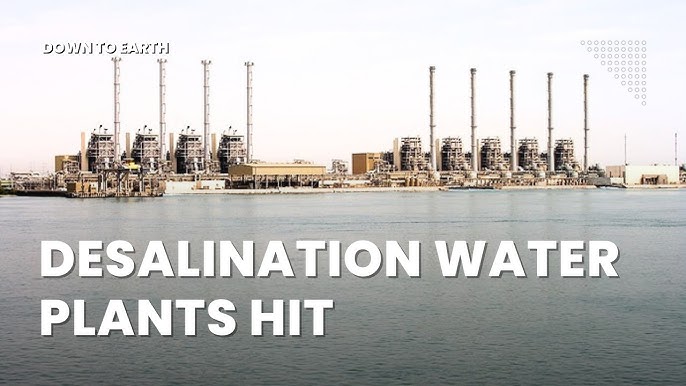
Iran’s response has fundamentally altered the equation. Iran warned that any direct attack on its energy infrastructure would trigger retaliation not only against oil assets but also against critical civilian infrastructure across the Gulf region—particularly desalination plants. These facilities are the lifeline of countries such as Saudi Arabia, United Arab Emirates, and Qatar, where the overwhelming majority of drinking water depends on desalination.
This is where the conflict crosses a critical threshold. Oil represents economic power, but water represents life itself. By signaling its willingness to target desalinated water systems, Iran has introduced a new dimension of deterrence—one that transforms the conflict from a traditional military confrontation into a potential humanitarian crisis.
For Gulf nations, this threat is existential. Unlike oil, which can be sourced or stored, water—especially in arid environments—has no immediate substitute. A disruption in desalination plants could leave millions without access to safe drinking water within days. This vulnerability has made Gulf states particularly sensitive to escalation and has pushed them to quietly urge restraint.
The United States appears to have taken these risks seriously. The possibility that a strike on Iran’s oil infrastructure could trigger a wider regional response—including attacks on allied territories and critical infrastructure—has likely contributed to a more cautious approach. The conflict, in such a scenario, would no longer remain confined to Iran but could engulf the entire Gulf region.
Meanwhile, Israel’s ongoing security concerns and military posture add another layer of complexity. The broader regional environment remains volatile, with multiple actors and overlapping interests increasing the chances of miscalculation. The strategic waterways of the region, particularly the Strait of Hormuz, further amplify the stakes, as any disruption there would have immediate global economic repercussions.
What is emerging is a classic “tit-for-tat” dynamic. Each threat invites a counter-threat; each action risks triggering a broader response. This cycle is inherently unstable, especially when it expands beyond military targets to include civilian infrastructure such as water systems. The cost of miscalculation in such a context is not just strategic—it is humanitarian.
In this environment, the restraint shown in not directly targeting Kharg Island’s oil reserves reflects an understanding of the broader risks involved. However, restraint alone is not a sustainable strategy. As long as the underlying tensions remain unresolved, the possibility of escalation continues to loom.
The urgent need, therefore, is to move beyond confrontation and toward diplomacy. Dialogue—whether direct or through intermediaries—must be prioritized. Confidence-building measures, de-escalation mechanisms, and regional engagement are essential to prevent the situation from spiraling out of control.
At its core, this conflict is no longer just about power or influence. It is about the protection of critical lifelines—energy and water—that sustain entire societies. Turning these into instruments of war would have consequences far beyond the immediate actors involved.
In conclusion, the Iran–US–Israel confrontation stands at a precarious crossroads. The threats surrounding oil infrastructure like Kharg Island and the potential targeting of desalinated water systems highlight how high the stakes have become. Continuing down the path of retaliation risks transforming a geopolitical conflict into a humanitarian disaster. Only a decisive shift toward diplomacy can break the cycle of escalation and ensure stability in a region that the world cannot afford to see descend into chaos.