

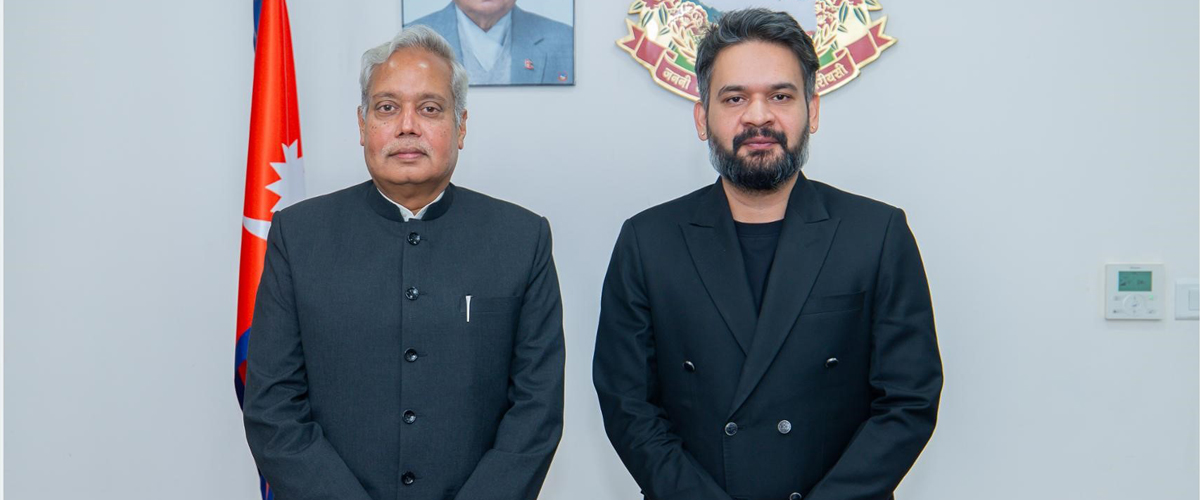
KATHMANDU- Prime Minister Balendra Shah’s separate meetings with the ambassadors of India and China on Monday are significant not because of what was discussed, but because of why they happened now and how they were conducted.
More than four months after becoming Prime Minister, Shah finally held his first one-on-one meetings with the ambassadors of Nepal’s two immediate neighbours. This comes after he had deliberately avoided such meetings and instead chosen to meet foreign ambassadors collectively.
That earlier decision was wrong.
When Shah assumed office, his refusal to meet ambassadors individually was presented as a departure from the old political culture. Meeting 17 ambassadors together was portrayed as a new and more equal approach to diplomacy. Politically, it may have looked attractive: Nepal would not give special treatment to any country, and the Prime Minister would not appear to be running after foreign diplomats.
But diplomacy does not work that way.
An ambassador is not simply a foreign visitor seeking access to the Prime Minister. He or she is the official representative of another government. Meeting ambassadors individually is a normal diplomatic practice and provides an opportunity for direct communication between governments. There was therefore little justification for treating individual meetings as something Nepal should avoid.
Now Shah has reversed that position. Changing one’s mind is not necessarily a weakness. A government can recognise that an earlier decision was mistaken and correct it. In fact, such correction can be a sign of maturity.
But the manner of the reversal is troubling.
Instead of gradually returning to normal diplomatic practice, Shah chose to meet the Indian and Chinese ambassadors back-to-back on the same day. This appears intended to send a message that Nepal gives equal importance to both neighbours. But it also gives the impression of a hurried correction-as if, after realising that the earlier approach was not working, the Prime Minister felt the need to correct it immediately and visibly.
Diplomacy requires more than simply demonstrating that India and China are being treated equally. Nepal’s relationship with India is different from its relationship with China. The issues, interests and sensitivities involved are different. A mature Prime Minister should understand these differences and engage each country according to the substance of the relationship, rather than treating diplomatic engagement as a matter of numerical balance.
This episode therefore raises a larger question about Shah’s understanding of foreign policy.
His initial decision appeared driven largely by his populist political instincts. His reversal now appears equally hurried. First, he rejected a normal diplomatic practice without sufficiently understanding its importance; now he has returned to it, but in a manner that seems designed more to correct the political impression than to demonstrate a carefully considered diplomatic strategy.
But Nepal’s relations with India and China are too important for foreign policy to become an experiment in political messaging. Diplomacy requires patience, consistency, judgement and an understanding of why certain practices exist. Monday’s meetings should therefore be welcomed as a return to normal diplomatic engagement. But they should also serve as a lesson for the Prime Minister.
The problem was not that Shah changed his position. The problem was that the original position was poorly judged, and the correction now appears to have been made in haste.
For a prime minister responsible for navigating Nepal between two powerful neighbours, that is an important lesson. Foreign policy should neither be used to demonstrate political novelty nor conducted through hurried symbolic gestures. It requires something more fundamental: knowing what Nepal’s interests are, understanding the nature of each relationship, and knowing when and how to engage.