

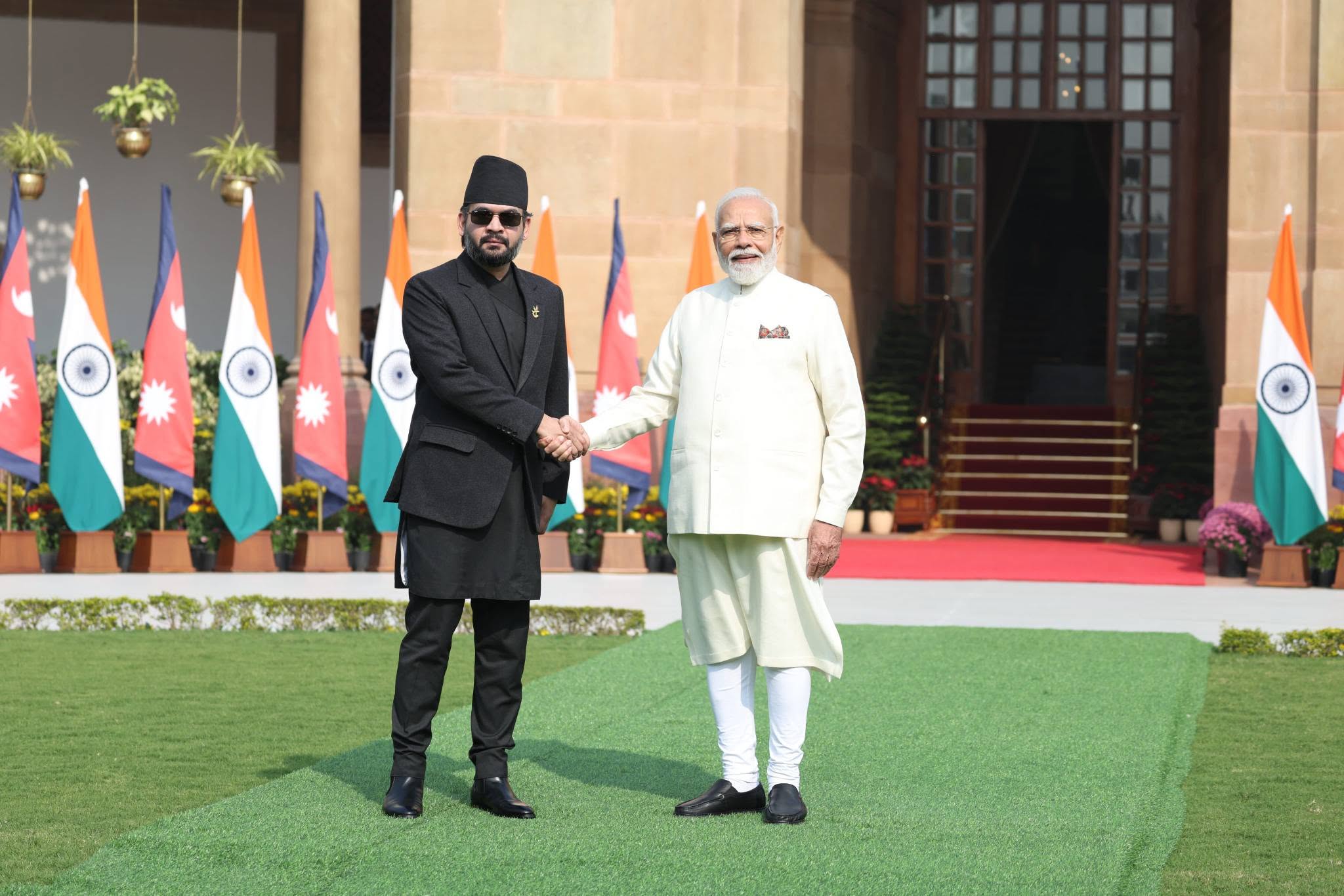
KATHMANDU- Prime Minister Balendra Shah’s state visit to India on November 22–23, 2026, has raised an important question about the relationship between political rhetoric and the realities of statecraft. The visit was significant not merely because it was his first bilateral visit to India after assuming office, but also because it revealed a noticeable transformation in his political posture towards Nepal’s southern neighbour.
During his tenure as mayor of Kathmandu Metropolitan City, Shah displayed positions that were widely interpreted as confrontational towards India. The placement of a map of Greater Nepal in his office, covering Lipulekh, Limpiyadhura and Kalapani was a particularly symbolic gesture. It reflected a political narrative that resonated with sections of Nepali society, especially among those who believe that Nepal should take a stronger position on historical territorial disputes. He had also made statements suggesting that he would raise Nepal’s boundary concerns directly with the Indian leadership.
His political rhetoric, therefore, created expectations that his premiership would bring a more assertive approach towards India. His earlier position that he would not visit India for at least a year after becoming prime minister further reinforced this perception. Yet, political realities changed considerably after he assumed the highest executive office.
Within months, Shah travelled to New Delhi for a state visit, held substantive discussions with Prime Minister Narendra Modi and concluded several agreements. More significantly, the boundary issue did not emerge as a separate political agenda during the visit. There was no fresh commitment on resolving the Kalapani-Lipulekh-Limpiyadhura dispute, nor was there a visible attempt to place the issue at the centre of bilateral negotiations.
It is true that the Joint Vision document mentions outstanding boundary issues and states that they should be resolved through mutual dialogue. However, this is a general diplomatic commitment rather than a concrete breakthrough on Nepal’s territorial concerns. The distinction matters.
The larger question is: why did Shah change his position so dramatically? Was it a genuine course correction after understanding the responsibilities of governing a sovereign state, or was his earlier rhetoric primarily intended to mobilise popular political sentiment?
There is nothing inherently wrong with revising one’s position. In fact, political maturity often requires leaders to distinguish between campaign rhetoric and the national interest. But foreign policy cannot be conducted merely through changing political preferences. It requires consistency, institutional memory and strategic clarity.
Shah’s apparent transition from revolutionary statements to restrained diplomacy raises a legitimate question: was he ultra-revolutionary in political expression but submissive in diplomatic action? Or has he recognised that Nepal’s national interests are better served through constructive engagement than confrontation?
Three Outcomes: Joint Statement, Joint Vision and Eight MoUs
The visit produced three major diplomatic outcomes: a 24-point Joint Statement, a 10-point Joint Vision document and eight memorandums of understanding. Each has a different diplomatic purpose and significance.
The 24-point Joint Statement primarily records the discussions, understandings, decisions and commitments made during the visit. It covers political relations, development cooperation, connectivity, energy, trade, security and people-to-people relations. It also acknowledges India’s humanitarian and technical assistance following the devastating Rasuwa-Bhotekoshi floods.
Among the significant announcements was India’s development assistance package of INR 15,000 crore, comprising INR 3,500 crore in grants and INR 11,500 crore in a rupee-denominated line of credit. The two countries also agreed to make the existing Bhairahawa-Lucknow air route bidirectional and expand Nepal’s transit connectivity. Projects involving railway connectivity, petroleum infrastructure and hydropower cooperation were also advanced. pmindia.gov.in+2
The second outcome, the 10-point Joint Vision titled Viksit Bharat and Samunnat Nepal: Re-imagining the Partnership, deserves particular attention. Why did the two countries need a separate vision document when they had already issued a Joint Statement?
A Joint Statement generally captures the immediate outcomes of a diplomatic engagement. A Joint Vision, on the other hand, is intended to provide a broader, forward-looking framework for bilateral cooperation. It identifies shared priorities and establishes a longer-term direction for the relationship. It is not necessarily a legally binding treaty, but it can provide political guidance for future negotiations, policies and institutional cooperation.
The 10-point document seeks to connect India’s aspiration of Viksit Bharat 2047 with Nepal’s aspiration of Samunnat Nepal. Its priorities include economic and development partnership, connectivity, energy and water resources, trade, digital cooperation, education, health, people-to-people relations, climate resilience and innovation.
Importantly, the document also recognises that existing bilateral arrangements, including the 1950 Treaty of Peace and Friendship, may be reviewed through mutual consent. It further mentions that outstanding issues, including boundary disputes, should be addressed through dialogue.
This is a significant diplomatic development. Rather than allowing historical disagreements to dominate the entire relationship, both countries have attempted to establish a framework for future-orientated cooperation. However, a vision document must not become merely an attractive diplomatic declaration. Its credibility will ultimately depend on implementation, measurable progress and the protection of Nepal’s national interests.
The third outcome was the exchange of eight MoUs covering different sectors, including forensic science, police training, civil service capacity-building, Ayurveda, satellite communications, sustainable urban development, health and pharmaceuticals, and animal husbandry and fisheries. These agreements demonstrate that bilateral cooperation is expanding beyond traditional areas into institutional, technological and social sectors.
Taken together, these three instruments represent different dimensions of diplomacy: the Joint Statement records immediate commitments, the Joint Vision establishes a strategic direction, and the MoUs provide sector-specific mechanisms for cooperation.
Nevertheless, Nepal must carefully assess the implementation of these commitments. Development assistance, particularly the concessional loan component, should be evaluated in terms of financial sustainability, national priorities and actual benefits to Nepal. Diplomatic success should not be measured simply by the number of agreements signed or the financial figures announced.
Diplomatic Course Correction or Political U-Turn?
Nepal and India share an open border, deep civilisational connections, extensive economic interdependence, religious and cultural links and a long history of cooperation. Their relationship is indispensable to Nepal’s economic development, trade, transit, energy security and regional connectivity. Therefore, maintaining friendly, stable and mutually respectful relations with India is not an option for any responsible Nepali government; it is a strategic necessity.
Equally, Nepal is a sovereign country with its own national interests, territorial concerns and independent foreign policy choices. Friendship with India should not require Nepal to compromise its sovereignty, just as Nepal’s sovereign decisions should not disregard India’s legitimate security and economic interests.
The problem in Nepal-India relations has often been the inability of political leadership to distinguish between domestic political narratives and the responsibilities of international diplomacy. Leaders sometimes adopt strong positions when they are outside government but become considerably more cautious after assuming executive responsibility.
Shah’s visit appears to reflect this transition. His government seems to have prioritised economic cooperation, connectivity, development assistance and improved political engagement over contentious bilateral issues. Such pragmatism is understandable. Nepal cannot afford to keep its relationship with India hostage to political rhetoric or historical disagreements.
However, there is another important question. Can a sovereign country simply leave behind the commitments, decisions and unresolved issues of previous governments? Certainly not. A change of government does not automatically erase the state’s institutional memory or its international obligations. Foreign policy may be adjusted, but continuity must remain its guiding principle.
The boundary dispute, the 1950 Treaty, the Eminent Persons Group report and other unresolved bilateral matters cannot simply disappear because a new prime minister has adopted a different diplomatic approach. They require consistent engagement, evidence-based negotiations and sustained political commitment.
India, too, should recognise that a stable and prosperous Nepal is in its long-term strategic interest. India’s genuine security concerns, connectivity interests and economic priorities deserve serious consideration. At the same time, India’s willingness to address Nepal’s legitimate concerns through dialogue will strengthen mutual trust and reduce the space for anti-India political narratives in Nepal.
The real test of Shah’s diplomacy will therefore not be how warmly he was received in New Delhi or how many agreements were signed. It will be whether his government can translate the commitments into tangible benefits while maintaining Nepal’s independent foreign policy and negotiating position.
Perhaps Shah has discovered that governing a country requires a different language from campaigning for political power. That is not necessarily a weakness. It can be a sign of political maturity. But if the transformation means abandoning previously articulated national concerns without a clear explanation or strategic justification, it raises questions about political consistency.
Nepal needs neither anti-India nationalism nor uncritical accommodation of India. It needs a mature, balanced and interest-based relationship with its closest neighbour. The challenge for Balendra Shah is to demonstrate that his diplomatic pragmatism is not a retreat from Nepal’s national interests but a more effective way of advancing them. A successful course correction would be welcome; an unexplained political U-turn would invite legitimate public scrutiny.