

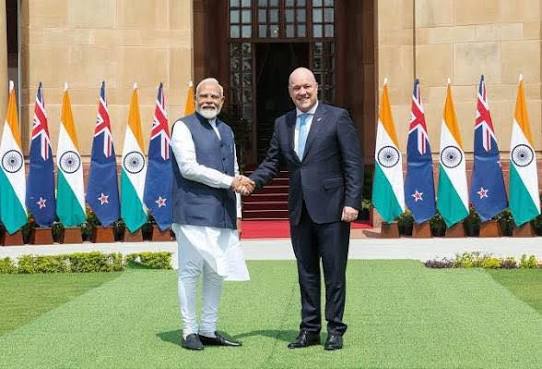
KATHMANDU – Prime Minister Narendra Modi’s official visit to New Zealand on 10-11 July marks a landmark moment in India’s diplomacy, becoming the first visit by an Indian prime minister to the country in four decades.
Coming just months after New Zealand Prime Minister Christopher Luxon’s visit to India in March 2025, the reciprocal exchanges underscore the growing momentum in bilateral relations and India’s expanding influence across the Indo-Pacific.
The visit culminated in the signing of ten agreements spanning trade, investment, agriculture, education, technology, workforce mobility, and maritime cooperation. The rapid conclusion of these agreements demonstrates the willingness of both governments to deepen cooperation while also reflecting India’s growing importance as a strategic and economic partner for New Zealand.
One of the major outcomes of the visit is the commitment to strengthen economic engagement. Although bilateral trade remains modest at around US$2.4 billion, both countries have set ambitious targets for expansion under the India-New Zealand Free Trade Agreement, signed in April 2026 and awaiting ratification. The agreement is expected to facilitate greater market access, encourage investment, and create new opportunities for businesses in both countries.
New Zealand is seeking wider access to India’s vast consumer market for products such as apples, kiwifruit, and Manuka honey, while India continues to safeguard its dairy sector to protect the interests of millions of small farmers. At the same time, cooperation in agricultural technology, food processing, research, and innovation is expected to create mutual benefits. Wellington’s commitment to invest US$20 billion in India over the next fifteen years further reflects growing confidence in India’s economic potential.
The visit also reinforced the importance of the Indian diaspora as a bridge between the two nations. With nearly 300,000 people of Indian origin residing in New Zealand, the community has become an important contributor to the country’s economy and multicultural society. Modi’s interaction with the diaspora highlighted India’s continued commitment to engaging overseas Indians while recognising their role in strengthening bilateral relations.
Beyond economic cooperation, the visit reflects India’s broader Indo-Pacific vision. Over the past decade, New Delhi has steadily expanded diplomatic engagement with countries across Southeast Asia and the Pacific under its Act East Policy and wider Indo-Pacific strategy. Strengthening ties with New Zealand fills an important gap in India’s regional outreach and reinforces partnerships with democratic nations committed to a free, open, and rules-based Indo-Pacific.
The strategic dimension of the visit has become increasingly significant amid shifting regional dynamics. Growing geopolitical competition, evolving security challenges, and uncertainty surrounding traditional security arrangements have encouraged countries across the Indo-Pacific to strengthen cooperation with trusted partners. India’s expanding role as a responsible regional stakeholder has made it an increasingly attractive partner for countries seeking greater strategic balance and diversified partnerships.
During the visit, both leaders reaffirmed their commitment to enhancing cooperation on maritime security, regional stability, disaster response, and Indo-Pacific affairs. These areas are expected to become central pillars of the bilateral relationship in the coming years, complementing growing economic and people-to-people ties.
The visit also demonstrated India’s ability to translate diplomatic engagement into tangible outcomes. Within a relatively short period following Prime Minister Luxon’s visit to India, the two governments were able to conclude a comprehensive strategic partnership framework, reflecting the maturity and growing trust in bilateral relations.
While the success of the newly signed agreements will depend on effective implementation, Modi’s visit has clearly elevated India-New Zealand relations to a new level. More importantly, it reinforces India’s emergence as a leading voice in the Indo-Pacific, capable of building durable partnerships based on mutual respect, shared democratic values, and common economic and strategic interests. As both countries work toward implementing the roadmap to 2030, the visit is likely to be remembered as a defining moment that laid the foundation for a stronger and more comprehensive partnership.