

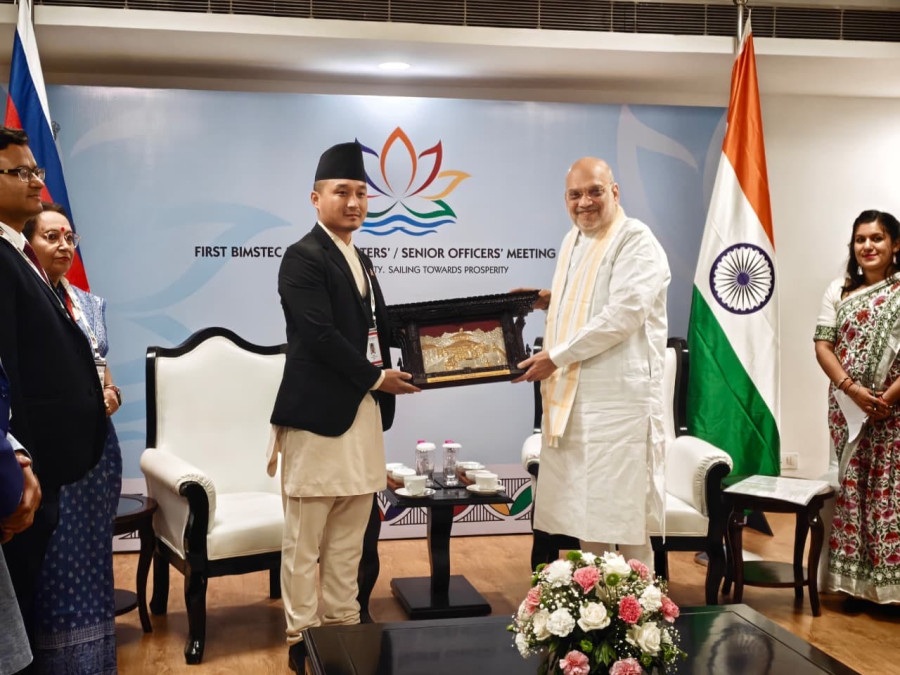
KATHMANDU – Nepal and India have agreed to enhance security cooperation, strengthen border management and step up efforts to combat transnational crime during a meeting between Home Minister Sudan Gurung and his Indian counterpart, Amit Shah, in New Delhi on Tuesday.
The meeting took place on the sidelines of the inaugural BIMSTEC Home Ministers’ Meeting. The two sides also discussed disaster preparedness and emergency response, according to a statement issued after the talks.
Gurung expressed gratitude to India for its timely assistance to Nepal following recent floods and landslides. He underscored the importance of practical cooperation that serves the mutual interests of both countries.
He also stressed that bilateral engagement should be based on sovereign equality, mutual respect and trust, the statement said.
The discussions come amid efforts by the two neighbours to improve security coordination along their 1,850-kilometre open border. Under longstanding bilateral arrangements, citizens of both countries can cross the border without passports or visas.
While the open border facilitates extensive social, cultural and economic exchanges, it also poses challenges in controlling cross-border crime, human trafficking, smuggling and the activities of criminal networks.
Nepal and India have established bilateral mechanisms to coordinate on border security, law enforcement and other security-related issues. Cooperation on disaster management has also gained importance as floods and landslides frequently affect communities, transport networks and infrastructure in both countries.
Recent disasters in Nepal have further highlighted the need for timely information-sharing, coordinated emergency responses and cross-border humanitarian assistance.
The meeting was held as part of the first BIMSTEC Home Ministers’ Meeting, which brought together representatives of member states to discuss regional security challenges and strengthen cooperation.
BIMSTEC comprises Bangladesh, Bhutan, India, Myanmar, Nepal, Sri Lanka and Thailand. The regional organisation has prioritised security cooperation, including counterterrorism and efforts to address transnational crime.
For Nepal, closer coordination with India remains significant given their open border, deep-rooted social and economic ties, and shared security and disaster-management concerns.