

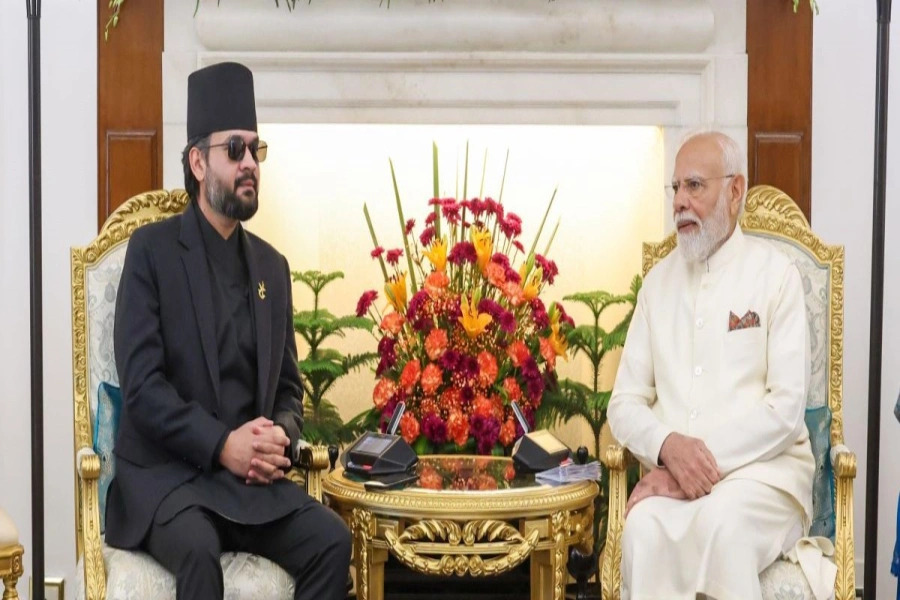
NEW DELHI – Nepal and India on Monday signed eight memorandums of understanding (MoUs) to strengthen bilateral cooperation in areas including security, forensic science, health, satellite communications, civil service training and urban development.

The agreements were signed during Prime Minister Balendra Shah’s official visit to India, marking an important step towards expanding institutional partnerships and sectoral cooperation between the two neighbouring countries.
Among the agreements is an academic and research collaboration between India’s National Forensic Sciences University, Gandhinagar, Gujarat, and Nepal Police’s Crime Investigation Department. Another MoU was signed between India’s Rashtriya Raksha University and Nepal’s National Police Academy to enhance cooperation in security education and training.
The two sides also agreed to strengthen capacity-building programmes for Nepali civil servants through collaboration involving India’s National Centre for Good Governance, Department of Administrative Reforms and Public Grievances, and Nepal’s Administrative Staff College under the Ministry of Federal Affairs and General Administration.
The remaining agreements cover cooperation in Ayurveda and traditional medicine, sustainable urban development, health and medicine, and livestock and fisheries development.
In another significant agreement, Nepal’s Ministry of Information and Communication and the Indian Space Research Organisation (ISRO) agreed to establish a satellite communication network to utilise the South Asia Satellite, expanding opportunities for regional connectivity and communication services.
The eight MoUs are expected to deepen cooperation through institutional linkages, knowledge-sharing, technical assistance and capacity development across multiple sectors.
During the visit, Prime Minister Shah and his Indian counterpart Narendra Modi also jointly inaugurated a motorable bridge connecting Darchula in Nepal with Dharchula in India and the second phase of the Motihari-Amlekhgunj petroleum pipeline project.
Following bilateral talks at Hyderabad House in New Delhi, the two leaders virtually laid the foundation stones for three additional projects: an integrated check post at Banbasa in India’s Uttarakhand state, a greenfield petroleum storage terminal in Jhapa, and the 669-megawatt Lower Arun Hydropower Project.
The leaders also virtually flagged off the Saryu-Kamala Express, a new passenger train service connecting Janakpur Dham in Nepal with Ayodhya Cantonment in Uttar Pradesh, India.
Taken together, the agreements, inaugurations and project announcements reflect a renewed emphasis on strengthening Nepal-India relations through connectivity, infrastructure development, institutional cooperation and people-to-people exchanges.