

KATHMANDU – Nepal’s Foreign Minister Shishir Khanal completed his China visit (June 14–17) after a one-week visit to India. This back-to-back diplomatic engagement reflects a long-standing feature of Nepal’s foreign policy, where India and China remain at the centre of Nepal’s external relations. It is important to underline that this is not a new approach introduced by any particular government but a consistent state practice shaped by geography, history, and strategic reality. In that sense, Nepal’s approach can be understood as a “Neighbourhood Priority with Equilibrium”, where priority is given to immediate neighbours while maintaining balance and strategic autonomy.
During the India visit, the whole gamut of bilateral relations was discussed, and three agreements were signed, which were largely continuation of earlier understandings. In a similar manner, during the China visit also, the entire range of bilateral relations was covered in high-level meetings. This shows continuity in Nepal’s diplomatic engagement with both neighbours. However, Nepal’s relations with India and China are distinct in nature and should be handled differently based on issue, context, and sensitivity. A one-size-fits-all approach does not work in Nepal’s foreign policy.
At the same time, Nepal’s new leadership is also relatively new to both neighbours. Therefore, these visits by Foreign Minister Khanal should also be understood as a process of mutual understanding, familiarisation, and review of overall relations, rather than expecting immediate policy shifts. At least, these visits signal that Nepal continues to attach the highest priority to India and China in its foreign policy architecture.
India and China, being two major emerging economies, are also increasingly influential in shaping the global order. Both countries are active in multilateral platforms such as BRICS, SCO, AIIB, and various Global South forums, where they raise issues of development and economic transformation. In this context, Nepal cannot ignore the importance of its neighbourhood. If Nepal has to achieve its national goal of “Prosperous Nepal, Happy Nepali”, then strong, stable, and friendly relations with immediate neighbours remain essential. At the same time, Nepal should maintain good relations with all countries and global powers in line with its independent and balanced foreign policy.
Continuity
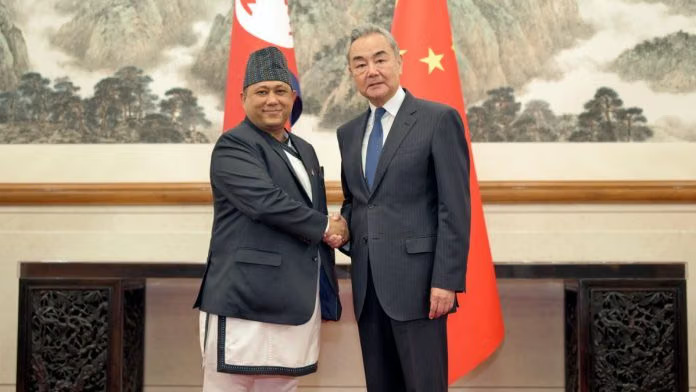
During the China visit in Beijing, Foreign Minister Shishir Khanal held bilateral meetings with Chinese Foreign Minister Wang Yi on June 15. He also met senior officials of the International Department of the CPC (IDCPC) and the leadership of the Chinese People’s Political Consultative Conference (CPPCC). He participated in an investment summit organized in Beijing and also interacted with the Nepali community in China. These were scheduled engagements, and all meetings carried their own importance, but the central focus remained the high-level bilateral meeting between the two foreign ministers, which lasted for around two hours.
During the meeting with Wang Yi, both sides discussed strengthening Nepal–China relations and expanding cooperation in key sectors. China reiterated its support for Nepal’s sovereignty, independence, and territorial integrity. Wang Yi also emphasized that China places Nepal in an important position within its neighbourhood diplomacy framework.
Similarly, discussions focused heavily on the Belt and Road Initiative (BRI). Both sides talked about advancing high-quality BRI cooperation, including highways, power transmission, border ports, and aviation connectivity. China again expressed support for transforming Nepal from a landlocked to a land-linked country. This concept was first clearly articulated during President Xi Jinping’s visit to Nepal in 2019, and since then China has been repeatedly stating it. However, in reality, this vision has not yet been fully translated into concrete large-scale implementation, and progress remains gradual.
The most important message of this visit is that Nepal is engaging China not only as a close neighbour, but also as a major global power. In recent times, there has been some debate that Nepal’s diplomatic engagements show a tilt towards Western countries, especially due to high-level engagements with the United States. Some observers have even linked this to a possible shift in power balance strategy. However, it is too early to draw such conclusions.
During the meeting, Foreign Minister Wang Yi also reminded the importance of geographical neighbours, with his clear message that “neighbours are more important than distant neighbours.” This statement can also be understood in the broader context of regional sensitivities and China’s concern about external presence in its periphery. At the same time, it was also a signal of expectation that Nepal should remain careful in maintaining balanced relations in its neighbourhood.
Overall, the discussions in Beijing were largely a continuation of past understandings. But at a deeper level, the visit also reflects a subtle reality: both sides are trying to understand the policy direction of the new leadership in Kathmandu. In response, Nepal has also clearly conveyed its position of maintaining balanced, independent, and issue-based relations with all partners.
Now the time is for action. Diplomatic visits and political messages are important, but the real test lies in implementation, delivery, and results on the ground that support Nepal’s development and connectivity ambitions.