

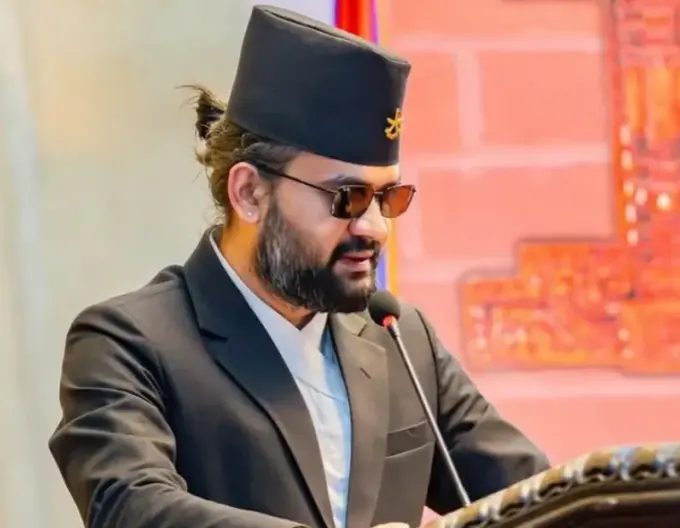
KATHMANDU – External Affairs Minister Shishir Khanal has clarified remarks made by Prime Minister Balendra Shah on the sensitive issue of the Nepal-India boundary dispute. On June 1, 2026, during a parliamentary discussion, the Prime Minister stated that the government had reached out to the United Kingdom regarding possible mediation in the dispute over the 372 sq km area of Lipulekh, Kalapani and Limpiyadhura.
The statement generated considerable debate in both Kathmandu and New Delhi. India’s Ministry of External Affairs promptly responded that there was no need for third-country involvement in the boundary issue and reiterated that Nepal and India possess established bilateral mechanisms to address such matters. The timing of the controversy was particularly noteworthy as RSP Chairman Rabi Lamichhane was on a visit to New Delhi from June 1 to June 5, 2026, holding high-level meetings with Indian leaders. However, he remained silent on the issue during his engagements.
The controversy has now largely been settled by Minister Khanal’s clarification during his official visit to India. Speaking at a press conference at the Embassy of Nepal in New Delhi on June 7, 2026, he categorically stated that Nepal had not sought the involvement of the United Kingdom in the Nepal-India boundary issue and that the matter would be resolved through bilateral negotiations. His statement reaffirmed Nepal’s longstanding diplomatic position and helped remove any ambiguity created by the Prime Minister’s remarks.
The clarification was important because Nepal has never formally sought British mediation in its boundary dispute with India. Successive governments of both Nepal and India have consistently maintained that outstanding border issues should be resolved through diplomatic dialogue based on historical evidence, treaties, maps and mutual understanding. Although progress has often been slow, the commitment to a bilateral process has remained unchanged.
Boundary disputes are among the most sensitive issues between neighboring countries. They require patience, careful diplomacy and sustained political engagement. Such matters cannot be resolved overnight, nor should they become subjects of unnecessary public controversy. The internationalization of a bilateral issue should not be considered before exhausting the diplomatic mechanisms that already exist between the concerned countries.
The Prime Minister’s parliamentary remarks also attracted attention for another reason. He stated that Nepal had encroached upon Indian territory in some places, just as India had encroached upon Nepali territory. This observation was widely debated because Nepal has traditionally maintained that its territorial claims are based on historical evidence and has not officially acknowledged encroachment into Indian territory. Following the controversy, the Prime Minister did not personally clarify his remarks, although members of his cabinet later attempted to explain that his intentions had been interpreted differently from what he meant to convey.
Minister Khanal’s intervention from New Delhi has therefore been significant. At a time when misunderstandings could have created unnecessary diplomatic discomfort, his statement helped reaffirm Nepal’s commitment to resolving the issue through direct engagement with India. Such clarity is particularly important when dealing with a neighbor with whom Nepal shares unique historical, cultural, economic and people-to-people ties.
Nepal and India undoubtedly have differences that require discussion, including the boundary dispute. However, the relationship between the two countries extends far beyond a single issue. Trade, transit, energy cooperation, connectivity, development partnership and close social relations remain equally important components of bilateral engagement. While the border issue deserves serious attention, it should not be allowed to overshadow the broader relationship.
This is not the time for third-party involvement or the internationalization of a bilateral dispute. Rather, it is a time to strengthen trust, maintain open channels of communication and pursue solutions through diplomacy. Without first fully utilizing bilateral mechanisms, calls for external mediation are unlikely to be productive and may even complicate the process.
Nepal and India have repeatedly demonstrated their ability to manage challenges and preserve their relationship. Both countries are capable of resolving outstanding issues through peaceful negotiations conducted in a spirit of mutual respect and understanding. Minister Khanal’s clarification has reinforced that approach and created a more conducive environment for future dialogue.
As Nepal moves forward, diplomatic maturity and strategic patience will be essential. Sensitive national issues should be addressed with precision and responsibility, particularly when they concern relations with a close neighbor. In this regard, Minister Khanal’s clarification was timely and constructive. It reaffirmed Nepal’s traditional diplomatic position and underscored an important principle: Nepal-India differences should be resolved by Nepal and India themselves, through dialogue, evidence and goodwill.