

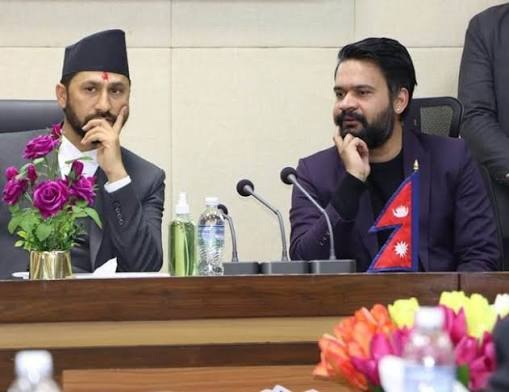
KATHMANDU- As several Nepalese ministers are visiting foreign countries for official programmes, a 20-member delegation of the ruling Rastriya Swatantra Party (RSP), led by General Secretary Bipin Kumar Acharya, is also departing for China tomorrow.
Prime Minister Balendra Shah and RSP President Rabi Lamichhane have instructed the delegation to make the visit productive and focus on Nepal’s national interests. According to Chief Whip Kabindra Burlakoti, Lamichhane emphasised proper preparation, discipline and active participation. The instructions indicate that the party leadership considers the visit an important political engagement rather than a routine foreign tour.
New Beginning
The invitation has come from the International Department of the Central Committee of the Communist Party of China (IDCPC), the CPC’s principal institution for maintaining relations with political parties worldwide. China has a long tradition of engaging with political parties representing different ideologies and political systems. Its relations are not limited to communist parties or organisations that share its political beliefs.
In Nepal, China has maintained political contacts with major parties, including the CPN-UML, Nepali Congress, Maoist Centre and other political organisations. These relations have continued despite frequent changes in government. This reflects Beijing’s consistent approach of maintaining broad political relationships rather than depending exclusively on the party in power.
The RSP’s emergence as the leading political force and its formation of the government have created a new opportunity for Beijing to establish direct institutional relations with the party. According to sources, RSP President Lamichhane was initially invited to visit China but later recommended General Secretary Acharya to lead the delegation. Acharya’s position makes him an appropriate representative for developing institutional relations between the two parties. Foreign Minister Shishir Khanal’s engagement and good relations with the IDCPC may also have helped create a favourable environment for this interaction.
The delegation’s meetings with both Prime Minister Shah and party President Lamichhane before departure also carry political significance. Shah reportedly advised the lawmakers on November 13 to focus on areas where Nepal could benefit from China, particularly trade, technology, tourism and agricultural modernisation. Lamichhane, in his meeting on November 14, emphasised preparation, discipline and the objectives of the visit.
These consultations appear to convey a message of political coordination between the government and party leadership. The RSP is a relatively new political organisation whose leaders come from different political backgrounds. Meeting both the Prime Minister and the party President may also be intended to dispel perceptions of internal differences or competing political positions.
However, the institutional nature of the visit must be clearly understood. The lawmakers are travelling at the invitation of the CPC, not as an officially mandated government delegation. Although they belong to the ruling party, they cannot negotiate bilateral agreements or make commitments on behalf of the Government of Nepal. Their role is to exchange views, explore opportunities, understand China’s development experience and report their observations and recommendations to the government after returning home. China also understands that this is a party-to-party engagement, not government-to-government diplomacy.
Development Partner
For Nepal, China is an important neighbour and development partner with considerable economic and technological potential. Its achievements in infrastructure, industrialisation, poverty reduction, digital technology, agricultural modernisation and public service delivery offer valuable lessons for Nepal.
The RSP delegation’s programme reportedly includes discussions on good governance, economic development, public service delivery, institutional capacity building and political leadership. The lawmakers are also expected to visit Sichuan, Hangzhou and Beijing to observe industrial development, technological innovation and post-earthquake reconstruction, including the experience of Wenchuan, which was devastated by the 2008 earthquake.
These are relevant areas for a country like Nepal, which continues to face challenges in infrastructure development, employment generation, agricultural productivity and industrial expansion. China’s development experience cannot be mechanically replicated because Nepal has its own political system, economic structure and development priorities. Nevertheless, learning from its experience and adapting useful practices to Nepal’s circumstances would be a sensible approach.
China has consistently expressed its willingness to support Nepal’s economic development and connectivity. During Foreign Minister Shishir Khanal’s official visit to Beijing in June 2026, he held discussions with Chinese Foreign Minister Wang Yi and Liu Haixing, Minister of the IDCPC. The two sides discussed expanding party-to-party exchanges as well as cooperation in infrastructure, connectivity, trade, energy, investment, agriculture, technology and tourism. This engagement provides a favourable background for strengthening relations between the CPC and RSP.
While the China visit is a positive development in Nepal-China political engagement, it also raises questions about the RSP’s foreign policy orientation. The party has emerged as a major political force with a strong electoral mandate and now carries the responsibility of governing the country. However, its long-term foreign policy doctrine, particularly its approach towards immediate neighbours India and China, remains insufficiently clear in the public domain.
The RSP has shown interest in engaging with both neighbours. Lamichhane’s earlier engagement with India and the proposed visit to China indicate that the party recognises the importance of maintaining direct political contacts with both countries. However, diplomatic engagement alone does not constitute a coherent foreign policy.
Nepal’s geographical position demands a consistent, predictable and balanced neighbourhood policy. Relations with India and China should not be driven by changing political moods or individual leaders’ preferences. They require a clear understanding of national interests, economic priorities, security concerns and long-term development needs.
The RSP government must ensure that stronger engagement with one neighbour does not create unnecessary suspicion in the other. Nepal should expand economic cooperation with China while maintaining its historically close, multifaceted and people-to-people relationship with India. Neither relationship should be viewed through the lens of geopolitical competition.
For China, the visit is an investment in a relationship with an emerging political force in Nepal. For the RSP, it is an opportunity to understand an important neighbour and develop a more informed approach to international affairs. For Nepal, the ultimate objective should be a stable relationship with China, a strong partnership with India and an independent foreign policy guided by national interest.