

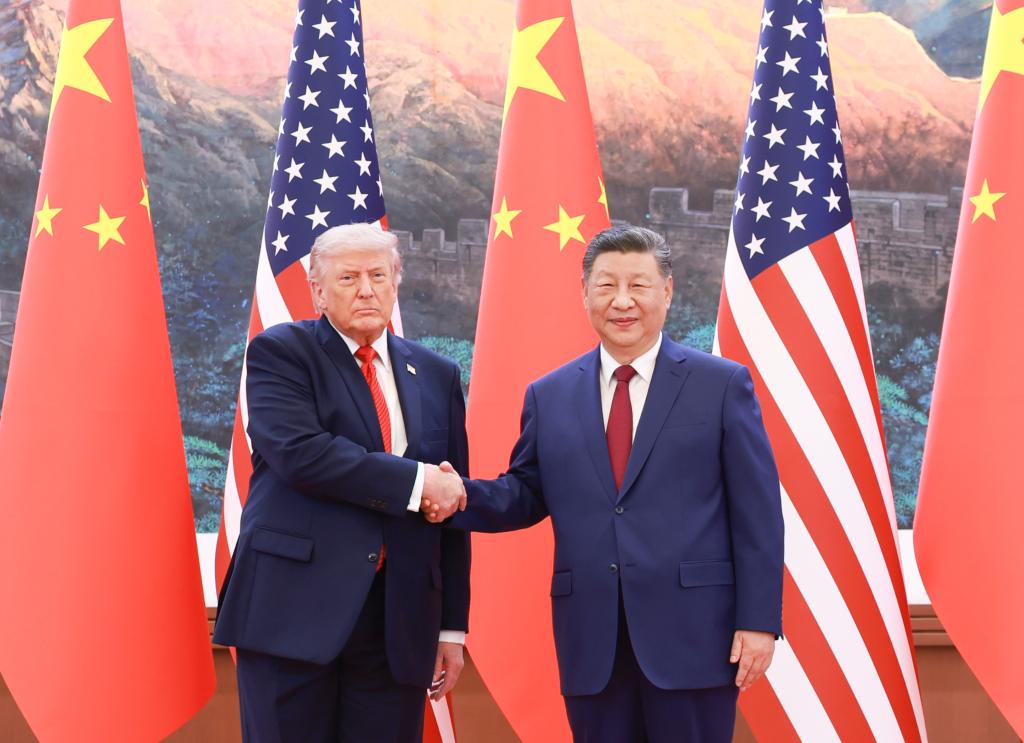
US President Donald J. Trump made a state visit to China on 13–15 May 2026, nine years after he first visited China in 2017 as President. After a long gap in high-level engagement between the two countries, this visit marked a notable moment in bilateral diplomacy. Interestingly, it was President Xi Jinping who extended the invitation on both occasions.
A key dimension of this engagement is the personal rapport between Trump and Xi Jinping. Despite periods of strategic rivalry and tensions, particularly over trade and technology, both leaders have maintained channels of direct communication and pragmatic engagement. They have frequently interacted on the sidelines of major global forums and international events. Such engagement reflects an important aspect of contemporary global diplomacy, where competition and cooperation often coexist simultaneously.
Following Trump’s visit, Russian President Vladimir Putin also traveled to China on 19–20 May 2026. While Putin and Xi Jinping share a relatively closer convergence of strategic outlook regarding the evolving international order, Russia’s relations with the United States have remained more complex and selective in nature. The near-simultaneous engagement of these three major leaders with China within a short diplomatic period carries important symbolic and strategic implications.
At the same time, the Prime Minister of Pakistan, Shehbaz Sharif, is visiting China from 23–26 May 2026. Although this visit does not carry the same geopolitical weight as the earlier engagements, it remains significant in the broader regional context. Pakistan has recently played an active diplomatic role in regional dialogue involving the United States and Iran. Pakistan Army Chief Asim Munir has also reportedly contributed to diplomatic efforts aimed at reducing tensions. President Trump’s recent announcement regarding a possible peace understanding with Iran has added further attention to these diplomatic developments.
Nevertheless, the visits of Trump and Putin to Beijing remain among the most consequential diplomatic developments of the present moment. These back-to-back engagements underscore Beijing’s growing centrality in global politics. Although the geopolitical motivations of Washington and Moscow differ considerably, both leaders’ engagements with China signal a broader structural shift in the international system. These developments are not merely bilateral interactions; they reflect deeper transformations in the global balance of power, economic interdependence, and strategic alignment.
For decades, the international order was largely shaped by Western powers led by the United States. However, China’s rise as an economic, technological, diplomatic, and increasingly strategic power has significantly altered the geopolitical landscape. The fact that both the United States and Russia, despite their own rivalry, continue to seek sustained engagement with China highlights Beijing’s expanding influence in global affairs.
For countries like Nepal, situated between two major Asian powers and increasingly affected by global geopolitical competition, understanding these shifts is essential. Nepal’s foreign policy choices, economic strategy, and diplomatic balancing will inevitably be influenced by this evolving global order.
China at the Center
One of the clearest messages emerging from these high-level engagements is that Beijing has become an increasingly important center of global power politics. Whether it is the United States managing strategic competition or Russia seeking deeper economic and political cooperation amid Western pressure, both recognize China’s central role in contemporary international affairs.
For the United States, these engagements may also indicate a transition from the earlier discourse of “decoupling” toward a more calibrated approach often described as “de-risking.” Rather than pursuing complete economic separation, Washington appears to be seeking a balance between strategic competition and selective cooperation. Recent diplomatic interactions suggest a growing recognition that long-term global stability requires sustained engagement between the world’s two largest economies.
Donald Trump’s approach toward China has often been assertive, particularly regarding trade imbalances, technology competition, and industrial policy. During his presidency, he introduced tariff measures, criticized Chinese economic practices, and advocated reducing U.S. dependence on Chinese manufacturing. Yet, even amid competition, Trump consistently emphasized the importance of direct engagement with Chinese leadership. This reflects a broader geopolitical reality: the United States may compete with China, but it cannot ignore it.
In contrast, Vladimir Putin’s engagement with China reflects strategic necessity shaped by Russia’s evolving relationship with the West. Following sanctions and strained ties with Western countries, Russia has increasingly turned toward China for economic cooperation, energy trade, financial coordination, and diplomatic support. As a result, China has emerged as one of Russia’s most significant strategic partners.
Together, these developments convey a clear message: China is no longer a peripheral actor in global politics but an increasingly central participant in shaping the emerging international order.
Economically, China is deeply embedded in global supply chains and remains a leading trading partner for many countries. It plays a major role in infrastructure development, manufacturing, digital technology, renewable energy, and regional connectivity initiatives. Through frameworks such as the Belt and Road Initiative, China has further expanded its global economic footprint.
Beijing has also become more active in multilateral institutions and regional cooperation platforms, including BRICS and the Shanghai Cooperation Organization, while strengthening engagement with the Global South. China and India have also shown areas of convergence on issues concerning developing countries and global governance reform. Symbolically and strategically, repeated engagement by competing global powers with China reinforces the reality of an evolving multipolar world order in which Beijing occupies a central position.
Strategic Multipolarity
A second major implication of these developments is the gradual transition from a unipolar system toward a more complex structure of strategic multipolarity. Following the end of the Cold War, the United States emerged as the dominant global power, shaping international institutions, financial systems, military alliances, and technological standards. However, the rise of China and the reassertion of Russia have progressively contributed to a more diversified distribution of global power.
Contemporary global politics is increasingly characterized by multiple centers of influence rather than a single hegemonic power. China’s economic rise, Russia’s strategic activism, the growing influence of middle powers, and the emergence of alternative institutions all point toward this transformation. Countries such as India, Indonesia, Turkey, Brazil, Saudi Arabia, and South Africa are also playing increasingly influential roles in this emerging multipolar landscape.
The engagements between Trump, Putin, and Xi Jinping illustrate how major powers are adjusting their foreign policy strategies in response to these shifts.
For the United States, China remains the principal competitor capable of challenging its position across economic, technological, and strategic domains. This has made China a central focus of American foreign policy regardless of domestic political leadership. For Russia, closer alignment with China serves as a counterbalance to Western pressure and helps preserve strategic autonomy in a constrained geopolitical environment. For China, these dynamics reinforce its image as a supporter of multipolarity, global connectivity, and development-oriented cooperation.
This transition carries both opportunities and risks. On one hand, smaller states may gain greater diplomatic flexibility by engaging with multiple centers of power. On the other hand, intensified great-power competition may increase geopolitical uncertainty, economic fragmentation, and external pressure on smaller and developing countries. In some regions, strategic rivalry may also encourage stronger geopolitical competition among regional powers.
In Asia, these dynamics are particularly visible. The Indo-Pacific has become a major arena of strategic interaction involving the United States, China, India, Russia, and other regional actors. Economic corridors, security partnerships, technological competition, and infrastructure diplomacy are becoming increasingly interconnected.
Implications for Nepal
For Nepal, these global shifts carry important geopolitical and strategic implications. Historically, Nepal’s foreign policy has been shaped by its location between India and China. King Prithvi Narayan Shah famously described Nepal as a “yam between two boulders,” emphasizing the importance of strategic balance and diplomatic caution. However, the geopolitical environment of the twenty-first century is considerably more complex than during his era.
Today, Nepal’s strategic environment extends beyond its immediate neighborhood. Nepal is influenced not only by India and China but also by broader global dynamics involving the United States and other major powers. Initiatives such as the Millennium Challenge Corporation Compact, the Belt and Road Initiative, Indo-Pacific strategies, and regional connectivity frameworks reflect this expanded geopolitical context.
China’s rise presents Nepal with significant opportunities in areas such as trade, infrastructure development, tourism, digital connectivity, hydropower cooperation, and regional integration. Trans-Himalayan connectivity, in particular, has the potential to reshape Nepal’s economic geography by improving access to wider Asian markets.
At the same time, Nepal must carefully manage its foreign policy to avoid becoming an arena of great-power rivalry. As global competition intensifies, smaller states often face pressure to align with competing strategic frameworks. Nepal’s long-standing principles of non-alignment, sovereign equality, balanced diplomacy, and peaceful coexistence therefore remain highly relevant.
Rather than adopting binary geopolitical positions, Nepal should continue to pursue issue-based diplomacy guided primarily by national interest. The emerging multipolar order also provides Nepal with opportunities to diversify partnerships across sectors such as climate diplomacy, education, technology, tourism, energy, and trade.